

According to the 2024 UN World Water Development Report:
“Water for Prosperity and Peace” (last updated 26 February 2024), worldwide, agriculture accounts for roughly 70% of freshwater withdrawals. The report continues “…Since (the) 1980s the global demand for freshwater has been increasing by just under 1% per year…”
Credit: UNESCO
Whereas the word agriculture suggests extensive farming such as rice and grassland, for the purpose of this blog I will assume it includes intensive horticulture as well.
It is not too much of a stretch to imagine that the acquisition of soil moisture and soil tension data in growing crops can go some way to optimise the application of irrigation water.
Water is expensive and it’s a resource under stress. Optimising irrigation can reduce costs and increase yields.
Over-use of irrigation leads to water wastage, possible root damage and it provides a pathway for ground or surface water contamination. Of the plant major nutrient requirements, nitrogen, assimilated by plants as nitrates, are very mobile. When you over-water you are simply leaching the nitrates back into the groundwater or river.
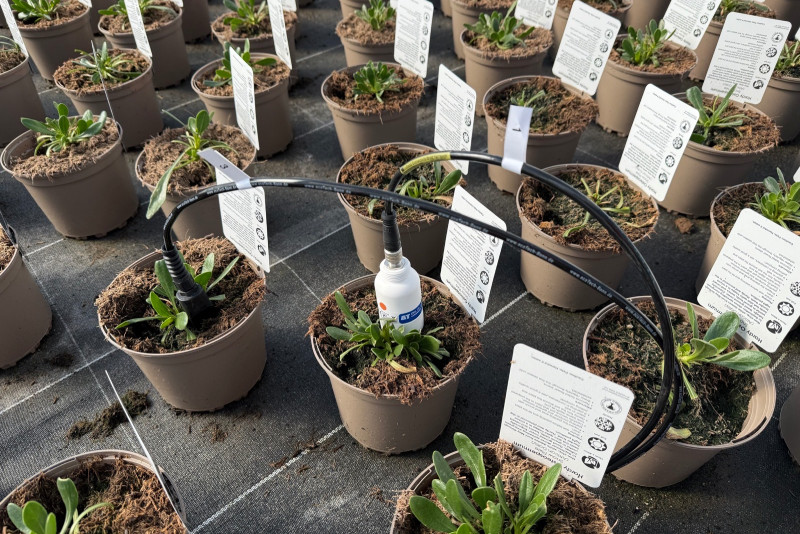
Whereas it is currently not possible to measure residual nitrate content in a soil directly, low cost sensors are now readily available which can measure volumetric soil moisture content (VMC) and a soil’s matric potential.
In simplistic terms, VMC tells us how much water is in the soil mix and the matric potential tells us how much of that water is available to the plant.
Volumetric Moisture Content sensors will report what percentage of water there is in a volume of the soil mix and therefore reports as a percentage unit and the matric potential sensors report in hPa or more easily as the logarithmic value, pF.
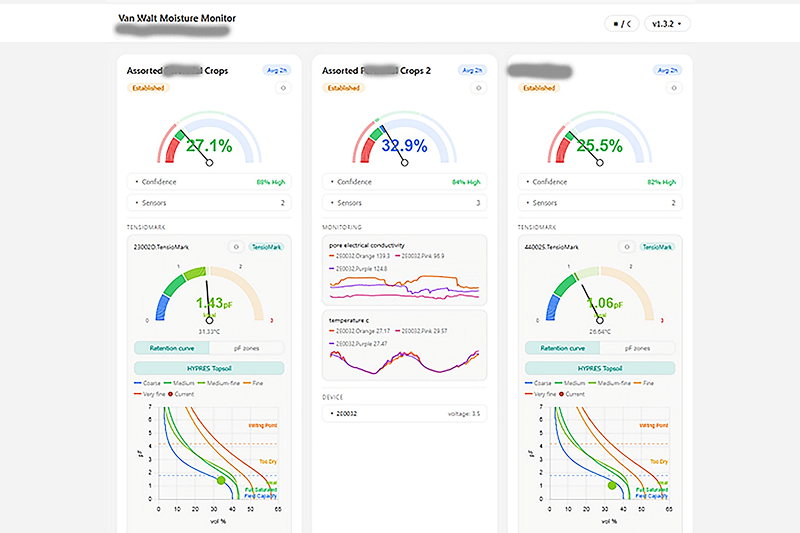
Two concepts are important when measuring soil tension. The first is Field Capacity (FC) which is the status where water is preserved within the soil pores against gravity. This can vary depending on the soil type but it will be in a window around pF2. The second is the Permanent Wilting Point (PWP) which is defined as the minimum amount of water in the soil that a plant requires to avoid wilting, typically at around pF 4.2.
From the grower’s point of view they should aim at an irrigation which lies within the Field Capacity zone for the specific soil type. Field capacity per soil type can be determined by the creation of a soil moisture retention curve for the particular soil matrix at the respective location.
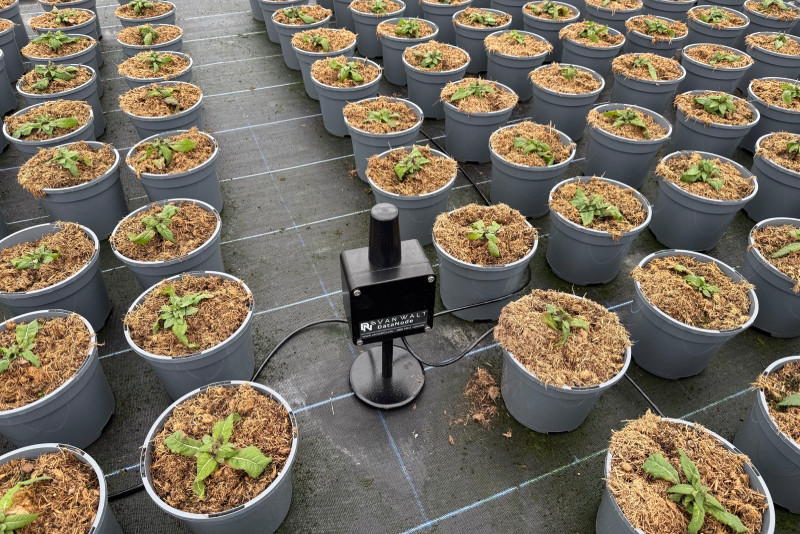
For a typical Van Walt installation we tend to deploy clusters of VMC and matric potential sensors either at a single depth or at multiple depths depending on the crop.
The sensors will be connected to a radio frequency data node. This device energises the sensors and forwards the measurements to a centrally placed GSM or satellite data gateway for onward transmission to a cloud server (vanwaltPULSE) for customer visualisation and download. Data is normally collected at a 15 minute measuring frequency.
The aim is to assist the grower in maintaining soil moisture within a reasonable band for the particular crop and soil matrix and a pF which lies within the field capacity zone.
The Van Walt Moisture Monitor was especially developed in house to give growers and farmers an easy visualisation of the conditions within a specific irrigation station. Giving the growers these additional tools will enable them to mesh their growing experience with actual soil specific parameters so they can fine-tune their irrigation with the aim of preserving crop quality while possibly reducing water usage.
Vincent van Walt, August 2026
From site survey to installation, we partner with you at every stage. With over 40 years of experience, our team can guide you to find the best solution for your application. Contact us to discuss your project.