


Since 1984, IMKO has been active in soil moisture measurement using TDR technology. In addition to volumetric moisture, the measurement signal also provides indications of electrical conductivity and therefore of fertilization status. Especially for fast-growing crops and specialty crops, this information is essential for targeted control of water and nutrient supply.
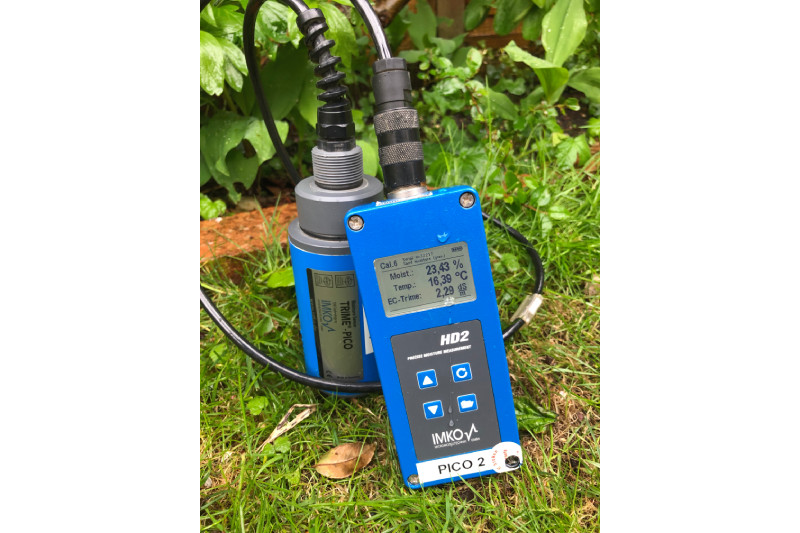
Viticulture clearly illustrates how important precise measurement data are in arid and semi-arid regions. When natural water sources run dry, climate- and site-adapted irrigation becomes increasingly important. IMKO technology helps use resources efficiently and safeguard harvest quality.
The benefits of measurement technology are also evident in processing: in Scharfenberger’s EUROPRESS EP2, IMKO moisture measurement technology is used to precisely determine the residual moisture level at which the must is separated. In this way, IMKO accompanies the process chain quite literally from the vineyard into the glass.

Material moisture is a bit like marriage: two people talk about the same thing and understand something entirely different. The reason is that whenever a value is stated as a percentage, the reference basis plays an important role. Put differently: without knowing the underlying definition, a moisture value in percent alone is often not unambiguous. In moisture measurement, application-specific standards have become established, so confusion is almost inevitable.
The first step is to clarify whether volumetric or gravimetric moisture provides relevant information. Volumetric moisture describes the volume fraction of water in the material. It indicates how much of a sample’s volume is occupied by water. This is useful when the amount of water per unit volume is the focus, for example in soil science, hydrology, and flood forecasting. Volumetric moisture can also be advantageous for materials with low bulk density, such as sawdust. Gravimetric moisture, by contrast, considers the mass fraction of water. It indicates what proportion of the material sample’s mass is attributable to water. This is a very practical parameter in weighing and dosing processes. Both moisture definitions are linked via density.
However, even within each moisture definition, it must additionally be checked whether the moisture value refers to the wet or the dry material. Thus, 10% moisture can mean that:
100 ml water, approximately 100 g, is added to one kilogram of dry mass:
100 g water1000 g dry mass= 10%10% moisture based on dry mass
one kilogram of weighed material consists in total of 100 ml water, approximately 100 g, and 900 grams of dry mass:
100 g water900 g dry mass + 100 g water= 10%10 % moisture based on total mass
Sounds confusing? It is. But how relevant is this practice? To handle moisture data and convert it quickly when needed, we have expanded our IMKO Toolbox.
In addition to a calculator for all 16 conversion directions between the four common moisture definitions, the current version now also offers the option of transforming existing material calibrations. The volumetric calibration curve supplied as standard with the PICO probes can thus be converted into a gravimetric calibration curve in no time.
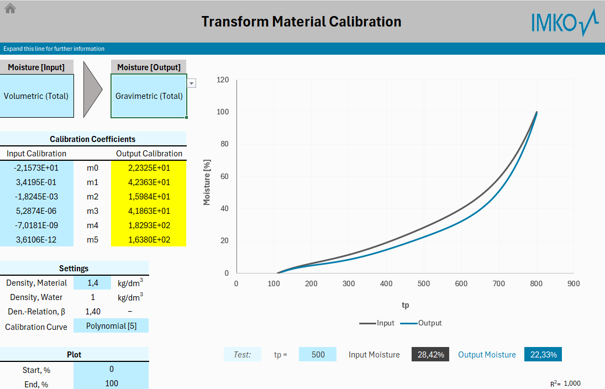
For example, for a truckload of soil, the water content can be determined in mass percent to calculate the material weight relevant for billing.
Blog: Courtesy of Cornelius Jantschke / IMKO GmbH
From site survey to installation, we partner with you at every stage. With over 40 years of experience, our team can guide you to find the best solution for your application. Contact us to discuss your project.